E-201 · Steel warehouse, Houston County
Electrical for warehouses and crane bays in Warner Robins
High-bay lighting and power in steel warehouses, worked from boom and scissor lifts beside fifteen-ton overhead cranes.
Dark aisles, and fixtures nobody can reach
A steel warehouse is built tall on purpose, and that height is exactly where electrical work goes wrong. In the bay we wired, the overhead travelling crane rides yellow girders with 15 TON painted on them, and everything the electrician hangs has to live around that bridge: the rails it runs on, the hook that parks at the end of the bay, the load that swings under it.
The usual trouble is not one big failure. It is circuits added piecemeal. A machine arrives, someone taps the nearest panel, a fixture gets moved to clear a rack, and ten years later nobody can say what feeds the lights over aisle four. Fixtures sit in the crane's shadow or in the path of the load, aisles go dim, and the floor crew works under a moving crane with half the light it needs.
Height makes it worse. A dead high-bay fitting stays dead because reaching it means renting a lift and clearing the floor beneath it, so a bay quietly loses a fixture at a time until the dark spots are simply how the building looks.
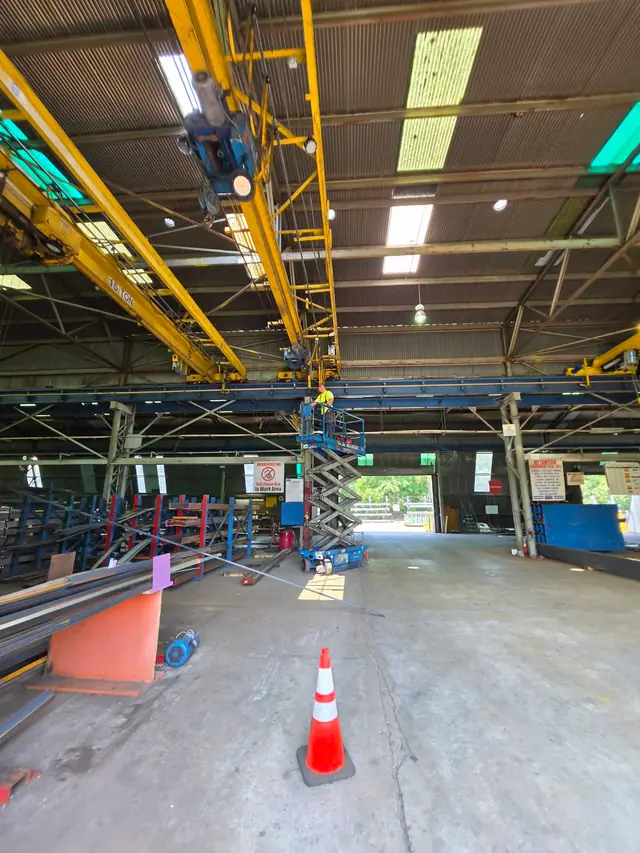
Steel warehouse with fifteen-ton crane girders and a 4A Electrical crew member on a scissor lift
Boom lift, scissor lift, and the crane's run
We start on the floor, walking the bay with the crane in mind: where the bridge travels, where the hook rests, which girders carry fixtures and which carry nothing but steel. That walk decides the lift. The blue boom lift reaches out over racking and along the girders. The green scissor lift goes straight up on clear floor, and a 4A Electrical crew member in hi-vis rides one or the other with a fixture, a whip and a drill.
Fixtures are fitted and circuited at height, not hoisted down and argued over. Each one is mounted, fed from a properly sized circuit, wired off and tested before the lift comes down, so the work never leaves a row of dead fittings overhead waiting for a second visit. Conduit runs follow the steel, boxes are set where a hand can reach them later, and each circuit is labelled at the panel so the next person finds what feeds the lights in a minute.
The schedule bends around the crane. A lift does not go up under a bridge that is about to move, so the work is planned around the crane's runs and the shift on the floor, and the lift is parked where the operator can see it. That is slower than hanging fixtures at random. It is also why the bay is lit when we leave.
Light where the operator and the floor crew work
The point of high-bay lighting is not a bright photo of an empty building. It is the crane operator seeing the hook, the load and the person guiding it, and the floor crew seeing the strap, the weld mark or the label they were sent to find. Fixtures are placed to that, in the aisles and over the pick faces, with the crane path kept clear of anything that could be struck.
Maintenance is planned in from the first fixture. When a lamp or driver eventually fails, the person facing it should know which circuit it is on, and should be able to reach it with the lift already on site rather than building a scaffold around it. A well-planned bay is one where the second visit is a quick job, not a project.
This is the same crew that wires custom homes in Houston County, and the habits carry over: labelled panels, tidy runs, boxes in the right place. The work in Warner Robins and Macon steel buildings simply happens a lot higher up.
Georgia LLC since 2016 · Mon to Fri 8:00 to 4:30 · (478) 365-3438