E-401 · Brick facade, downtown Macon
Gooseneck and architectural lighting on Macon brick
Gooseneck lanterns set level along historic brick in downtown Macon, with sealed boxes and runs planned on the elevation first.
Fixtures that fight the brick, and water behind the box
A historic downtown building in Macon is a hard wall to light. The brick is old, the mortar joints are soft, the courses are not perfectly level after a century, and the owner wants new lanterns that look like they were always there. Fixtures bought off a shelf and screwed on wherever a drill bit finds purchase end up crooked, unevenly spaced, and visibly wrong from the street.
The failure you cannot see is water. An exterior box set into an old masonry wall gives rain a straight path behind the fixture, and a box that is not sealed will eventually show it, as a tripped breaker, a rusted terminal or a stain running down the brick below the lantern. By the time that shows, the wall has already taken the damage.
The third failure is access. A run of fixtures along a second-storey line with no thought for how anyone will reach them means every dead lamp becomes a lift rental, and the building owner learns to live with a dark gap in an otherwise lit alley.
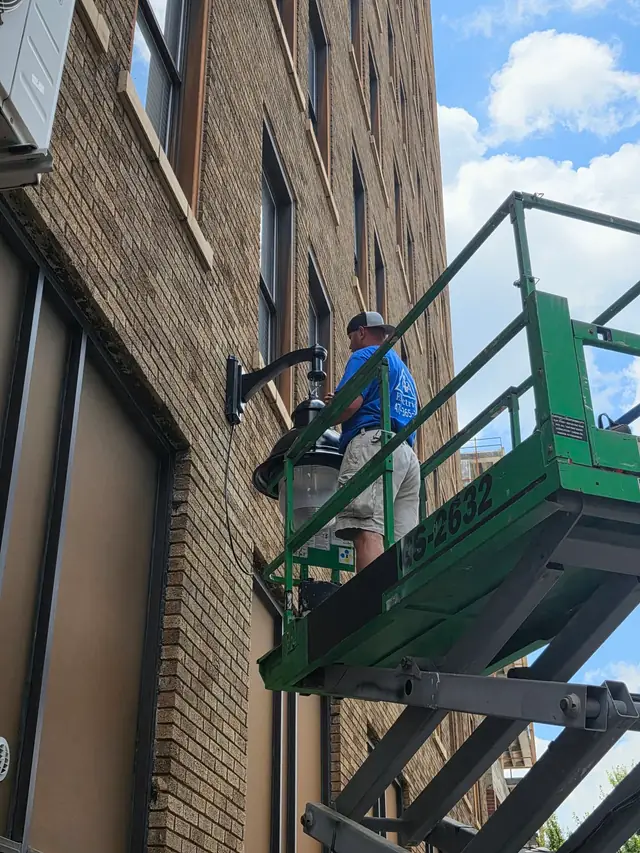
4A Electrical crew member in a blue company shirt on a scissor lift fitting a black gooseneck lantern to historic brick in downtown Macon
Laid out on the elevation, then done from the lift
Before a lift moves, the layout is worked out against the face of the building: where the doors and windows fall, where each black gooseneck lantern should sit, what the spacing is, and which courses of brick it lines up with. The line is set first and the fixtures follow it, so the lanterns read as a row instead of a scatter.
Then a 4A Electrical crew member in the blue company shirt goes up on the green scissor lift with the fixtures, and the work is done at height: boxes set and sealed against the wall, cable run where it is protected and out of sight, each lantern mounted level to the line and wired off. The two liveried trucks parked on the street below, ladder racks loaded, carry what the lift cannot, and everything is tested before the lift comes down.
Gooseneck lanterns reward this care. The arm throws light down the wall instead of out at passers-by, so the brick glows and the fixture itself stays dark and clean against it. That only works when every arm is set at the same height and reach, which is why the layout happens first, not last.
A lit alley, and fixtures you can still reach
The finished job shows in the alley. Along one brick elevation in downtown Macon the lanterns run in an even line, the same height, the same spacing, the same drop from the wall, and the alley reads as a place at night rather than a gap between buildings. A storefront lit this way looks cared for before anyone has read the sign.
Aftercare is built into the install. Fixtures are placed so a lamp can be changed without a rented lift where the building allows it, circuits are labelled at the panel, and the boxes stay sealed so the wall stays dry. That means the lighting is still doing its job in a few years, not just on the day the lift leaves.
We work out of Warner Robins and take this kind of job anywhere in Houston County and up into Macon. Exterior lighting is rarely the biggest job on a building, but it is the one everyone sees, which is a good reason to have it laid out properly. A line of lanterns that is level on day one stays level, and that is the part a passer-by quietly judges the whole building by.
Georgia LLC since 2016 · Mon to Fri 8:00 to 4:30 · (478) 365-3438