E-101 · Warner Robins, Houston County
New construction and custom home wiring
Rough-in to final on custom and new homes in Warner Robins and Houston County, walked through with the owner and the builder before a box goes on a stud.
Boxes in the wrong place once the drywall is up
A custom home gets wired twice. Once on the plan, and again in the field, when the framing is standing and somebody finally notices that the kitchen island has no receptacle, the garage hangs on a single circuit, and the panel is the smallest one that would have passed. By the time drywall is hung, every one of those fixes means cutting, patching and a second trip. Most of what goes wrong in a new house goes wrong in the weeks between the plan being drawn and the first box being set.
Around Warner Robins that gap is wide. An owner buys a lot, the builder frames fast, and the electrical decisions get made on a subfloor with a tape measure and a short deadline. The crew out of the Elberta Rd shop would rather have that conversation early, with the plan on the table and both the owner and the builder in the room, before a single box goes on a stud.
Panels are the other quiet trap. A panel sized for the house exactly as drawn has no room for the workshop someone adds in five years, the second charger for the driveway, or a standby generator. Leaving spare spaces and clean room in the enclosure costs very little during rough-in and a great deal afterward.
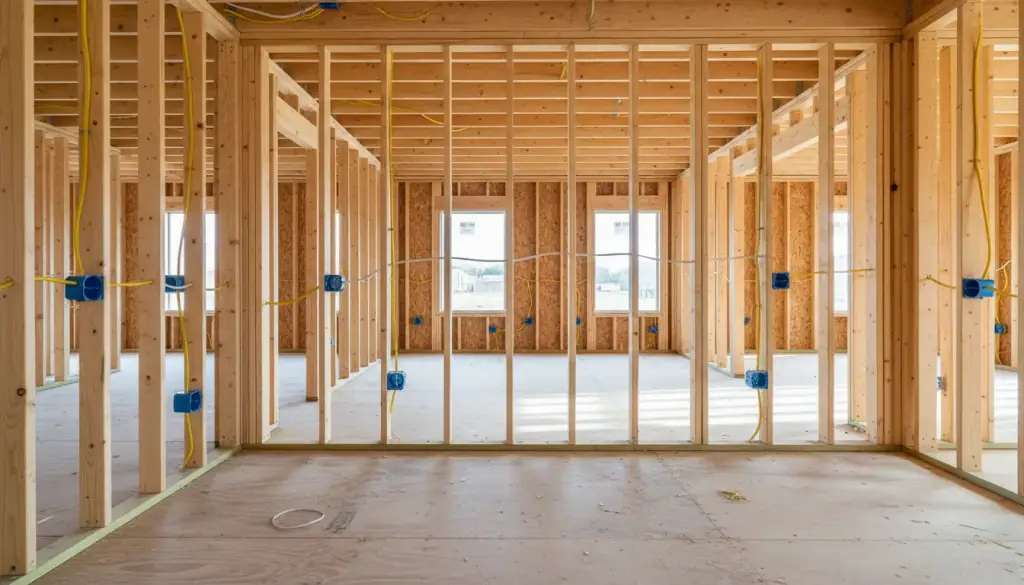
Framed house interior with blue outlet boxes and cable runs before drywall
Rough-in, county rough inspection, trim-out and final
The work follows the order a house is built in. It starts with a walk of the plan, with the owner and the builder, marking switch heights, receptacle spacing, fixture centres, and every place something heavy will hang from a ceiling box. Then comes rough-in: boxes set to the framing, cable pulled and stapled, home runs dressed back to the panel location, and pathways left open for data, cameras and doorbell wiring while the walls are still walls.
Nothing gets covered until Houston County has looked at it. The rough inspection happens with every box and cable still visible, which is when a missed support or a short run gets fixed in minutes instead of behind finished drywall. After the walls close, trim-out puts in the devices, plates and fixtures, dresses the panel, and labels every breaker in plain words instead of a pencilled "misc".
The final inspection comes last, with the house energized and the inspector testing what he finds. One homeowner who hired Glenn and his crew to wire a custom home described the whole process as professional, prompt and knowledgeable, and that order of work is a big part of why. The same liveried trucks with ladder racks that show up for rough-in are the ones that come back for trim-out, so the people who set the boxes are the people who finish the walls.
A Houston County final the inspectors remark on
A passed final is the minimum. What a family lives with for twenty years is what comes after it: a panel directory that matches the house, spare spaces where the next circuit will go, devices that sit square and flush to the wall, and fixtures centred on the rooms they light. None of that is visible to a building department, and all of it shows up the first time a switch is changed or a breaker is traced.
One Google reviewer, who had 4A do the electrical on a new home, wrote that even the Houston County inspectors commented on how well it was done. That is the kind of remark the work is aimed at. Inspectors see a great many houses in a season, and they notice when a rough-in is tidy enough that the inspection takes the shortest possible walk.
If you are planning a build in Warner Robins, Houston County or out toward Macon, bring the plan set and the questions you have about where things should go. The office at 1902 Elberta Rd answers Monday to Friday, 8:00 to 4:30, on (478) 365-3438, and it is closed Saturday and Sunday.
“Even Houston county inspectors commented on how well they did!” Kaitlyn Sinyard, Google review.