E-301 · Warner Robins and Houston County
Standby generator installation
Briggs & Stratton home standby generators with the transfer switch, so the house switches over on its own when the grid drops.
What fails when the grid does
Middle Georgia loses power in ordinary ways. A thunderstorm takes a line down on Elberta Road, a pine limb lands on a feeder, a transformer trips on a hot August afternoon. For a few hours it is an inconvenience. For a few days it is a freezer of spoiled food, a sump pump that stops, a well pump that stops, and a family working out where to charge the phones.
The usual stopgap is a portable generator and a bundle of extension cords run through a cracked window. It works until it does not. Someone has to be home to start it, fuel it in the dark and keep it running. The cords pinch in the window frame, the unit sits too close to the house, and nothing about the arrangement is wired to the panel, so the circuits you actually need stay dead while the ones you do not need sit idle.
The other failure is the unit that was never sized for the house. A generator picked off a shelf without a look at what the house draws will trip the moment the air conditioner and the water heater ask for power together. The fix is to count the load first, before anything is poured or bolted down.
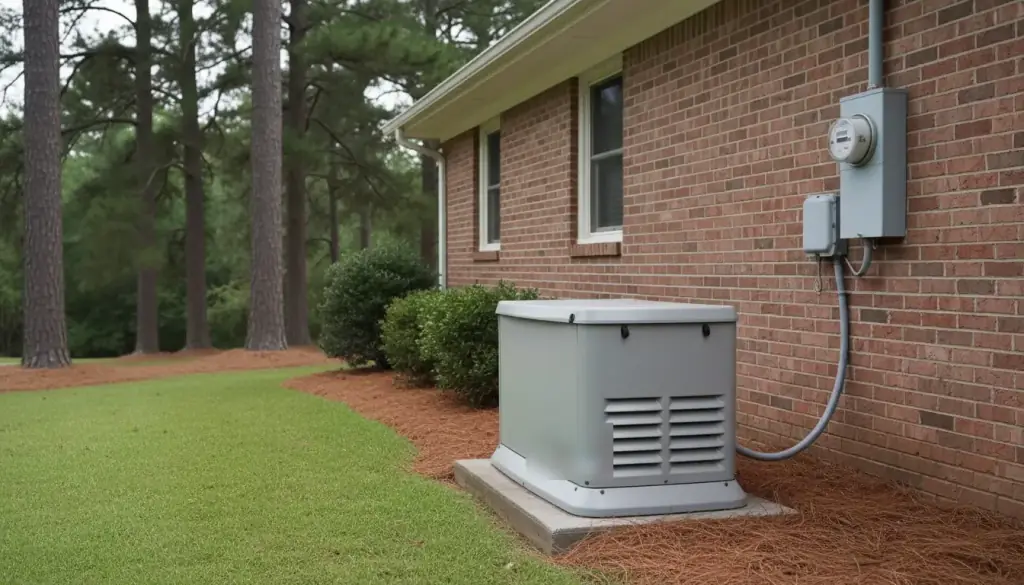
Grey home standby generator on a concrete pad beside a brick house
How a standby install goes, start to finish
It begins with a load review. We walk the house with you and the panel, list what has to stay running through an outage, and compare that against what the generator can carry. Which circuits matter to you is a real conversation: the refrigerator, the well pump, the furnace blower, the lights in the kitchen and the hall. Everything else can wait.
Placement comes next. The generator sits on a level pad, clear of windows, doors and fresh-air intakes, with room around it for service and airflow. We look at where the gas line and the electrical run can reach without crossing a driveway or a flower bed, and we keep the unit where it is reachable but not in the middle of the view from the back porch.
Then the tie-in. An automatic transfer switch goes in beside the service, so the house is isolated from the street before the generator feeds it. That separation is the safety point: power never backs out onto the line while a lineman is working on it. The gas connection and the electrical connection are made, the circuits are labelled, and the system is test run with you standing there, so you see the house switch over and switch back.
Aftercare, and what to check after a storm
A standby generator is only worth having if it starts the one night you need it. Home standby units are built to run a short exercise cycle on a regular schedule, usually weekly, so a dead battery or a fault shows up on an ordinary Tuesday and not in the middle of a storm. Learn the sound it makes during the exercise run. If it ever sounds different, that is your cue to call.
Plan on service visits as the manufacturer sets them out for your model: oil, filters, a look at the battery and the transfer switch. We can talk through that schedule when the install is finished, so it does not turn into a surprise a year later.
After a storm, walk out and check the pad before you check anything else. Look for debris against the enclosure, standing water around the base, and anything blocking the vents. Make sure the unit is back in automatic mode once the grid returns. If the house did not switch over, or the generator ran and the lights stayed off, call the office on weekdays between 8:00 and 4:30 and we will help you work out the next step.
4A installs Briggs & Stratton home standby generators. The company says so on its own Facebook page (WE PROUDLY INSTALL BRIGGS & STRATTON) and appears in the Briggs & Stratton locator at 1902 Elberta Rd, Warner Robins. To talk through a house, call (478) 365-3438.