Exterior Lighting on Older Brick Buildings: Placement, Sealed Boxes and Planning the Elevation
Brick that has stood for a century forgives a lot, but it won't forgive a light fixture set crooked or a wall box that lets water in.
October 21, 2026 · 4 min read
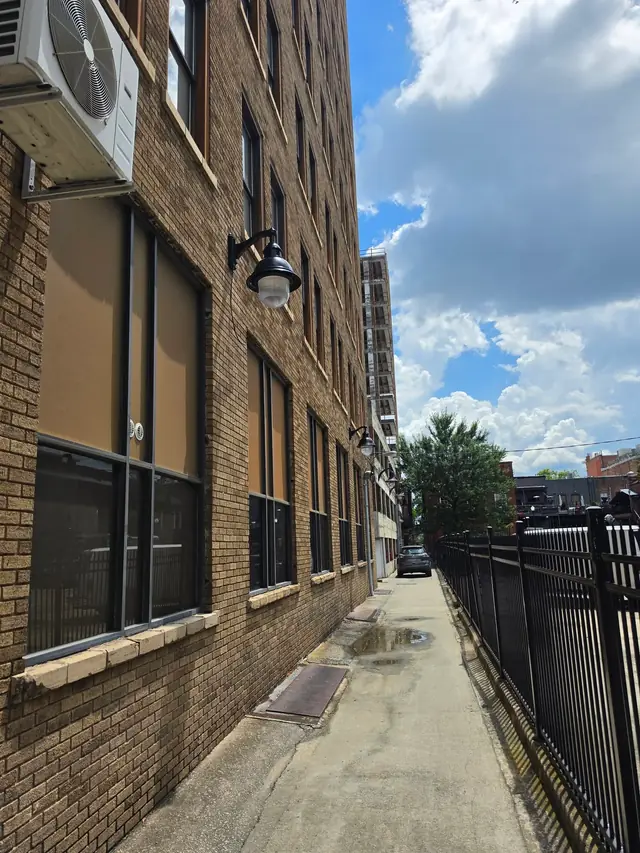
Old brick is not a blank wall
Lighting a historic brick building looks simple from the sidewalk. Pick a handsome fixture, mount it above the door or along the alley, and flip the switch. In practice the wall is the hard part. Century-old brick and soft mortar do not behave like new construction. The courses may not run level. The mortar may crumble where you drill. And the building probably has detail that deserves to be seen: arched openings, stone sills, corbelled cornices, painted signs.
Owners of older downtown buildings in Macon and around Middle Georgia often want the same thing: a warm, evenly lit front and side that makes the storefront or alley feel safe and inviting without fighting the architecture. Black gooseneck lanterns are a popular choice because they suit old brick so well. Getting them to look right is a matter of layout and careful installation.
Lay it out on the elevation first
The best exterior lighting jobs begin with a drawing, or at least a photograph with marks on it. An elevation is just the view of the wall straight on, and it shows how fixtures relate to doors, windows and rooflines. Mark where each fixture goes, check the spacing, and look for conflicts. A lantern placed too close to a downspout, a window head or a masonry joint line will always look like a mistake.
Consistency is what the eye reads. Fixtures set at the same height, on a line, with even spacing, make a wall look intentional. Fixtures set a few inches off look sloppy even from across the street. On brick, the mounting heights usually work best when they tie to something real, like the top of a door or a mortar course, rather than a tape-measure number alone.
Think about light direction as well. A gooseneck arm throws light down and outward. That is flattering for a sign or a doorway, and it can leave the upper wall dark. If the goal is to show off the building, ask how the light will fall across the brick at night, and consider how far the pools of light overlap between fixtures.
Keep water out of the box
Water is the enemy of every exterior electrical connection. Rain runs down a brick wall and finds the smallest gap. If it gets into a wall box, you get corrosion, tripped breakers and eventually a failed fixture or worse. Anything installed outside should be rated for wet locations, with gaskets in good shape and covers that seal.
Where a fixture meets the wall, the joint needs to be sealed so water runs away from the box instead of into it. On old brick, that usually means working with the masonry rather than against it: mounting into solid brick where possible, using appropriate anchors, and sealing around the fixture with a compound that suits the surface. Wire running into the building should enter in a way that sheds water, with a drip loop where it makes sense.
Wiring and getting to it later
A fixture will eventually need a new lamp, a new photocell or a repair, and that is a question you can answer on day one. How will someone reach it? Lantern heights of ten, twelve or fifteen feet usually mean a ladder or a lift. For a long alley elevation, a scissor lift can make the installation faster and safer, and it is the right tool when you are setting a row of fixtures to a line. Plan for the same access later. If a parked car, a tree or a fence blocks the lift, the maintenance cost climbs.
Controls are worth deciding up front. Photocells turn fixtures on at dusk, timers shut them off, and a switch inside gives the staff manual control. Running everything off one circuit with a clear label at the panel keeps troubleshooting simple. Where wire has to cross masonry, it should be protected in conduit and routed so it is neat and almost invisible once finished.
What a good result looks like
When it is done right, nobody talks about the wiring. They notice that the building looks good at night, that the alley feels lit, and that every lantern sits level and evenly spaced. The brick is undamaged beyond the neat holes the anchors needed. Water stays out, the fixtures come on when they should, and the next person to service them can find everything.
4A Electrical has installed black gooseneck lanterns on historic brick in downtown Macon, working from a scissor lift to set them on a line. If you own an older building in Warner Robins or Middle Georgia and want to talk through the elevation, call us at (478) 365-3438.
4A Electrical Ltd. Co., (478) 365-3438
Call (478) 365-3438More articles
Wiring a Custom Home in Houston County: What to Settle Before Rough-In
Electrical work in a new house happens in two stages, and almost every regret traces back to a choice that wasn't made before the first one.
Home Standby Generators in Middle Georgia: Sizing, Placement and Upkeep
A standby generator only earns its place on the night the grid goes down, and whether it does depends on decisions made long before then.