Home Standby Generators in Middle Georgia: Sizing, Placement and Upkeep
A standby generator only earns its place on the night the grid goes down, and whether it does depends on decisions made long before then.
October 21, 2026 · 4 min read
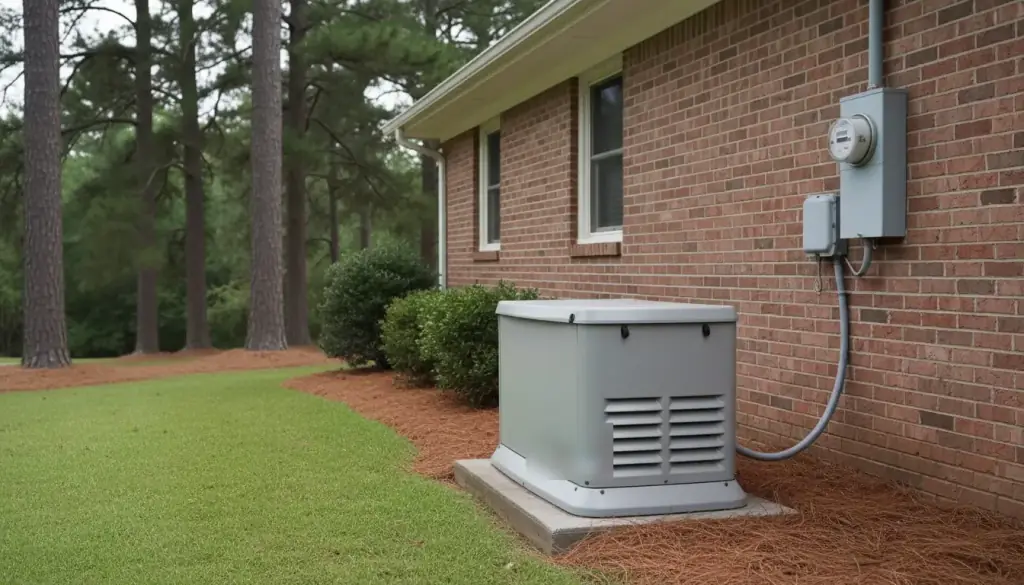
Why a portable generator stops being enough
Anyone who has lived through a long outage in Middle Georgia knows the routine. Storms, ice and downed lines take the power out, and a portable generator comes out of the shed. It gets fueled in the dark, run on an extension cord through a cracked window, and shut off every few hours to refill. It works, but it is loud, it takes constant attention, and it only covers whatever you can plug into it.
A standby generator sits outside the house like an air conditioning unit and is wired into your electrical system through a transfer switch. When the utility power drops, the switch senses it, the engine starts, and the house is back on in a short time without anyone going outside. When the utility returns, the switch hands the load back and the unit shuts down. That is the whole appeal: nothing to haul, nothing to fuel by hand, no cord through a window.
Sizing starts with what you want running
Generators are sized by the load they have to carry, and the first job is deciding what that load is. Some households want the whole house on backup, including central air. Others want only the essentials: refrigerator, freezer, well pump, a few lights, the furnace blower, internet, and one room's cooling. Both approaches are reasonable, and they lead to different equipment.
The step that gets skipped most often is the load review. An electrician looks at your panel, adds up the circuits you want covered, and pays attention to the heavy hitters. Air conditioners, electric water heaters, electric ranges, dryers and well pumps all draw far more when they start than when they run. A unit that looks big enough on paper can still struggle if two large motors try to start together. Pick a size from a brochure or a neighbor's setup and you risk paying for capacity you will not use, or being short exactly when it counts.
Fuel matters too. Many home units run on natural gas from the utility, others on propane from a tank. Natural gas means no refilling, but the gas line has to be sized for the engine. Propane means a tank on the property and a supplier to keep it filled. Either way, the gas work has to be done properly alongside the electrical tie-in.
The transfer switch is the part that keeps people safe
The transfer switch is not an accessory. It is what keeps your generator from feeding power backward onto the utility lines, which can seriously injure a lineman working to restore service. It also keeps the house from being fed by two sources at once. If a generator is ever connected to a house without one, the work is unsafe, and it should be corrected.
Some installations use a whole-house automatic switch that handles the entire panel. Others use a smaller switch that serves only a chosen set of circuits, which can let a smaller generator do the job. We install Briggs & Stratton standby generators, and the switch choice follows from the load review rather than the other way around.
Where the unit goes
Placement is partly code and partly common sense. The unit needs clearance from the house, windows, doors and vents, because engine exhaust must never find its way indoors. It needs a level pad and room around it for airflow and service access. It should be reachable for a technician with tools, and it should not sit where water collects or where a fallen limb can land on it.
There are practical trade-offs as well. The closer the unit is to the gas meter and to the panel, the shorter and cheaper the runs. But you also do not want it outside the bedroom window, since it will run for exercise cycles and during outages. A short walk around the property with the electrician usually settles it. Also check local rules and any neighborhood requirements before you commit, since the answer varies from place to place.
Exercise cycles and ongoing maintenance
A standby generator is an engine that sits idle most of the year, and idle engines fail. Most units run a short self-test on a schedule, often weekly, to keep things lubricated and to catch problems early. Leave that setting alone and keep the area around the unit clear of leaves, mulch and nesting insects.
Plan for service visits too. Oil, filters, spark plugs and the battery all wear out, and the battery is the most common reason a generator fails to start. Following the maker's service schedule is the cheapest insurance you can buy. After a long outage, check the oil level and note how many hours it ran.
If you are thinking about standby power for your home in Warner Robins, Houston County or anywhere around Macon, call 4A Electrical at (478) 365-3438. We will start with your panel and your list of what has to stay running.
4A Electrical Ltd. Co., (478) 365-3438
Call (478) 365-3438More articles
Wiring a Custom Home in Houston County: What to Settle Before Rough-In
Electrical work in a new house happens in two stages, and almost every regret traces back to a choice that wasn't made before the first one.
Lighting a Warehouse or Crane Bay: High-Bay Fixtures and Working Around Overhead Cranes
Good lighting in a crane bay is mostly planning: where the crane travels, how crews reach the fixtures, and what happens on the day one of them fails.