Lighting a Warehouse or Crane Bay: High-Bay Fixtures and Working Around Overhead Cranes
Good lighting in a crane bay is mostly planning: where the crane travels, how crews reach the fixtures, and what happens on the day one of them fails.
October 21, 2026 · 4 min read
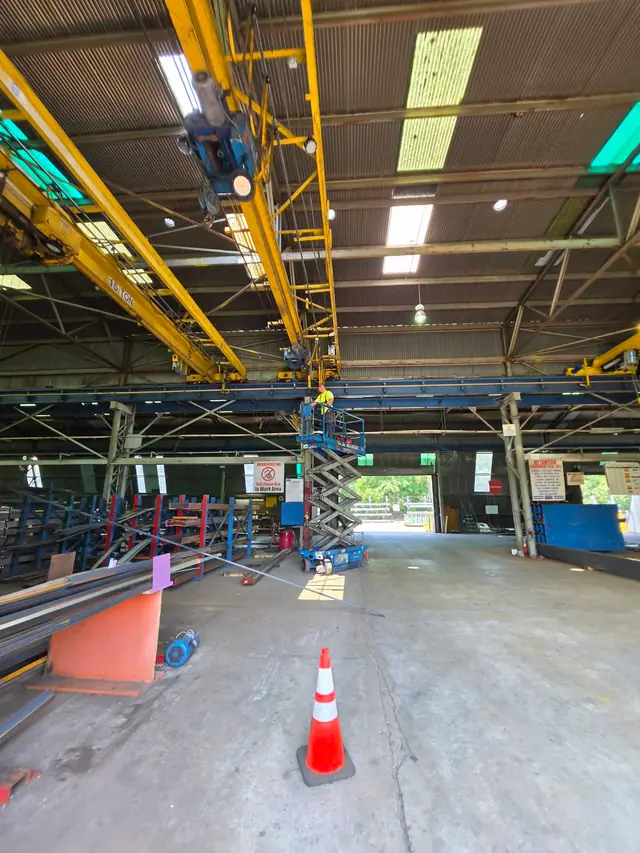
A crane bay is a different kind of lighting job
Lighting an office is mostly about comfort. Lighting a steel warehouse with overhead cranes is about safety, visibility and access. The ceiling may sit thirty or forty feet up, with crane girders, trolleys and hooks occupying the very space where you would normally hang a light. Operators need to see the load and the floor. Floor crews need to see each other. And somebody, eventually, has to get up there and change something.
Plant managers and building owners tend to call after the problem shows up: dark aisles, glare in the operator's eyes, fixtures that were installed where the crane can't pass, or lamps that nobody can reach without shutting down production. Most of these are planning problems, and most are avoidable.
Start with where the crane travels
Before choosing a single fixture, map the crane. Where do the runway beams sit, how far does the hook travel, and what is the lowest point of the bridge and trolley? A fixture hung in the crane's path is a collision waiting to happen, and one hung above the girders may be blocked by them from lighting the floor. The best positions are usually between runs or mounted on the girders and building steel in places the equipment can never reach.
Walk the bay while the crane runs and watch the operator's sightline. Light should come from a direction that does not wash out the load or shine into the cab. Spacing matters as well. Fixtures set too far apart leave dark bands between pools of light, and those bands show up exactly where people walk.
Choosing high-bay fixtures
High-bay fixtures are built for tall spaces, and modern LED versions have mostly replaced older metal halide units. They turn on at full output, use far less power for the light they produce, and last much longer between replacements, which matters when each replacement means renting a lift. The questions worth asking are about the building, not the catalog.
- How high is the mounting point, and what beam spread covers the floor without gaps?
- Is the air dusty, damp or corrosive, and does the fixture have the right enclosure for it?
- Will the fixtures be on dimming or sensor controls, and how are those wired?
- Are exit and backup lighting needed, and do they have to tie into the same circuits?
- Can a crew reach each fixture from the floor with a lift, or does something block the way?
Controls deserve thought too. A big bay does not always need every fixture at full output. Zoned switching lets a night crew light only their area, and occupancy sensors can handle storage aisles. But sensors high above a moving crane can misread motion, so test them in the real space before you commit.
Doing the work at height
Installing fixtures in a crane bay takes the right equipment. Boom lifts and scissor lifts put a crew at the fixture without climbing, and they let an electrician mount, wire and test at height. That equipment also needs floor space, and in an active warehouse the floor is rarely empty. The work has to be scheduled around the crane's runs and the shift's traffic, with the crane locked out and tagged whenever a crew is working in its path.
Circuiting happens at height too. Each fixture needs power from a properly sized circuit, wiring that is supported and protected from vibration and heat, and a disconnect that makes sense when someone needs to work on it later. Adding fixtures piecemeal onto whatever circuit is nearby is how bays end up with overloaded runs and no one who can say what feeds what. Labeling every circuit at the panel and at the fixture row costs little and pays off on the first maintenance visit.
Plan the maintenance before you install
The last question is the one people forget: how will the fixtures be serviced? A light that cannot be reached without stopping the crane, clearing a production line and renting a lift is a light that stays dead for months. Ask during design where a lift can sit under each row, how high it will reach, and whether any equipment blocks it.
Keep a simple record of fixture type, row location and the circuit each one is on. Keep a few spares on hand. These small steps decide whether a failed fixture is a ten-minute swap or a week of annoyance.
4A Electrical has worked in steel warehouses with overhead crane bays, putting up high-bay lighting from boom and scissor lifts. If you manage a building in Warner Robins, Macon or elsewhere in Middle Georgia and want a walk-through, call (478) 365-3438.
4A Electrical Ltd. Co., (478) 365-3438
Call (478) 365-3438More articles
Wiring a Custom Home in Houston County: What to Settle Before Rough-In
Electrical work in a new house happens in two stages, and almost every regret traces back to a choice that wasn't made before the first one.
Home Standby Generators in Middle Georgia: Sizing, Placement and Upkeep
A standby generator only earns its place on the night the grid goes down, and whether it does depends on decisions made long before then.